China's LFP battery market is shaking things up
 https://n.news.naver.com/article/092/0002350406?sid=105
|
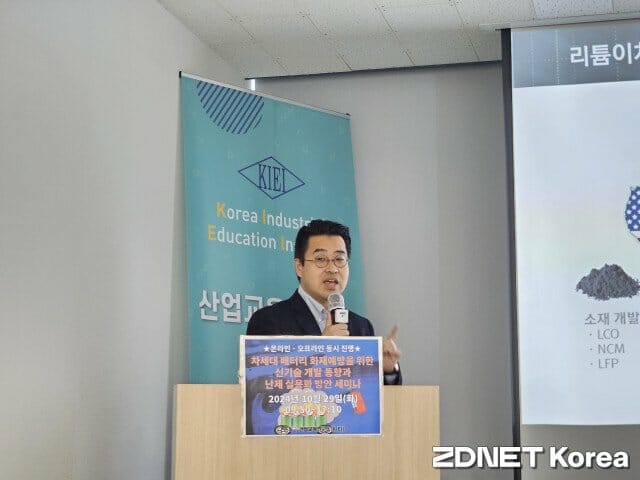
Next-Generation LMFP with Manganese Additions Gaining Attention… Domestic Companies Also Belatedly Rush to Develop "If nickel-cobalt-manganese (NCM) batteries represent 'innovation,' then lithium-iron-phosphate (LFP) batteries represent 'improvement.'" Kim Su-jin, CEO of Remplir, made these remarks at a seminar titled "New Technology Development Trends and Challenges for Commercialization of Next-Generation Battery Fire Prevention," held at the Industrial Education Research Institute in Guro-gu, Seoul on the 29th.
Giving a lecture titled "Key Technology Development Trends in LFP Materials: Case Studies and Prospects, and Key Challenges Regarding Fires," Kim stated, "Battery development will largely proceed in two directions : developing new concept batteries with new materials and structures, or improving existing products." He added, "While Korea has been focusing on developing innovative products like all-solid-state and lithium-sulfur batteries, China has been focusing on improving LFP batteries by enhancing safety and extending driving range."
Kim Su-jin, CEO of Remplir (Photo = ZDNet Korea)
This research by Chinese companies is beginning to pay off. LFP batteries, previously overlooked for their lower performance and heavier weight than ternary batteries like NCM and NCA, are transforming the market landscape. Market research firm SNE Research predicts that LFP batteries will account for more than half of the global secondary battery market share by 2030.
To respond, Korea's three major battery companies are also accelerating their LFP battery development efforts. CEO Kim explained, "Currently, LFP is not made from a single material. We are exploring various ways to improve cost, increase stability, and boost energy density, such as by using a mixture of solid-state and liquid-state synthesis methods. We have also streamlined the process by adopting dry mixing and a continuous precursor production system, thereby reducing costs."
He continued, "To compensate for the shortcomings of NCM, which have lower energy density and low-temperature susceptibility, battery packs are being developed in China, such as those that incorporate NCM at the edge of the vehicle and LFP in the middle. Hybrid battery pack systems that combine LFP and sodium-ion batteries are also being developed." He added, "While materials development has been stagnant for the past 20 years, active material development has been underway recently."
A prime example is the LMFP battery, which is attracting attention as a next-generation battery. LMFP replaces some of the iron used in the cathode with relatively inexpensive manganese, maintaining the cost and safety of LFP while achieving higher energy density. However, there are technical challenges to overcome. While energy density can be further increased by increasing the manganese content, higher manganese levels lead to structural instability. Other challenges include dual-voltage platforms, low electronic conductivity, low lithium-ion diffusion rates, and capacity loss during fast charge/discharge. To address this, efforts are being made to optimize the manganese-to-iron ratio, nanomaterialization, particle structure and shape control, surface carbon coating, and bulk ion doping.
CEO Kim stated, "In addition to manganese doping, various other doping materials, such as magnesium, zinc, and aluminum, are being widely used these days." He added, "The current hot topic is improving energy density and lifespan while also improving ignition stability and structural performance." He continued, "Research into materials to create cheaper and more stable batteries will continue. To achieve this, R&D is necessary for all four materials : not only the cathode, but also the anode, electrolyte, and separator." |