Will NCM Battery's Leading K-Battery Become the Second Semiconductor?
Concerns are growing due to fire vulnerability, high dependence on China, and rising material prices.
|
Lithium iron phosphate battery patent expires this year, increasing market share based on stability. "We must respond to changes by developing diverse batteries rather than focusing on a single type." Will Korea (K) batteries grow into a second semiconductor industry? While orders secured through collaborations with global automakers amount to hundreds of gigawatt-hours (GWh), many challenges remain to be overcome for sustained growth in the mid- to long-term.
The recent increase in electric vehicles equipped with lithium iron phosphate (LFP) batteries has raised concerns about K-battery's core lithium-ion ternary (NCM, nickel cobalt manganese) batteries.
◆ LFP patent expires this year = These concerns have been heightened by Tesla's adoption of LFP batteries across all entry-level models. Tesla has decided to expand LFP installation to all "Standard" models, which are short-range models. Tesla used both LFP and nickel-cobalt-aluminum (NCA) batteries in its Model 3 Standard, sold in China. This means that going forward, the Model 3 and Model Y will use LFP batteries instead of NCA batteries. Volkswagen also announced at its Power Day event last year that it would use LFP batteries in its entry-level models. Ford also announced its intention to use LFP in commercial electric vehicles. According to Hi Investment & Securities and industry sources, LFP batteries currently account for 11% of all batteries used in electric vehicles.
NCM and NCA batteries are estimated to account for 86%. According to Chinese media, four of the top 10 electric passenger vehicles sold globally last year were equipped with LFP batteries. All models are produced in China. The Tesla Model 3 and Model Y are prime examples of electric passenger vehicles equipped with batteries from CATL, a Chinese LFP battery manufacturer.
Wuling's "Hongguang Mini EV" also uses LFP batteries from four companies : CATL, Guoxuan, Fenghui, and Ruifu Energy. BYD's "Song Pro Plus PHEV" is equipped with LFP-based blade batteries from BYD subsidiary Pudi Battery. The battery industry cites the expiration of LFP patents this year as the primary reason for the inevitable increase in LFP battery market share. Patent issues were one of the reasons LFP batteries were previously produced and consumed only in the Chinese market.
According to Samsung Securities, LFP patent restrictions will expire at the end of 2022. With the expiration, export restrictions outside of China will also be lifted. Chinese LFP products are expected to leverage their price competitiveness to increase their market share in the low- to mid-priced electric vehicle market.
Kim Su-jin, CEO of LFP battery manufacturer Remplir, said, "With the expiration of the LFP battery patent this year, overseas sales of cathode materials will become possible. The use of LFP batteries is bound to expand going forward." Remplir plans to begin mass production soon, improving energy density by adding manganese to the cathode material to improve efficiency by more than 10%.
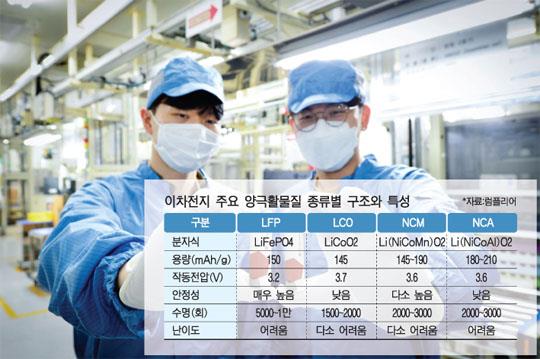
◆ Rising prices of key ternary materials = LFP batteries and ternary batteries use different cathode materials. LFP batteries use lithium iron phosphate as the cathode. Recently, manganese has also been used in the cathode to improve battery efficiency. NCM batteries use a cathode material that combines lithium with cobalt, manganese, and magnesium. With the significant increase in electric vehicle sales last year and the decline in mineral mining due to the COVID-19 pandemic, prices of key battery materials are rising.
According to Benchmark Mineral Intelligence (BMI), from January 1, 2020, to mid-January this year, battery-grade cobalt prices rose 119%, nickel sulfate prices rose 55%, and lithium carbonate prices rose 569%. The price volatility of iron and phosphoric acid used in LFP batteries is less than that of ternary batteries. LFP batteries offer greater price competitiveness, and this trend is expected to become even more pronounced going forward. BMI predicts the worst material shortage on record this year, driven by the recent surge in demand, labor issues, and ongoing disruptions due to COVID-19.
◆ Higher nickel content increases fire susceptibility = NCM batteries increase their nickel content to improve efficiency. However, as nickel content increases, so does their susceptibility to fire. Recently, concerns about the fire risk of vehicles equipped with ternary batteries have led to an increase in recalls. Last year, General Motors' Bolt EV and Hyundai's Kona EV were recalled due to fire susceptibility.
Recently, Renault's Zoe was recalled after discovering a battery defect. While it takes time to determine the cause of the recall, the cost of recalls in the trillions of won is forcing manufacturers to consider LFP, which offers greater safety, over high-nickel ternary batteries.
◆ High Dependence on China for Materials = Korea's dependence on China for key battery materials is deepening. According to the Korea International Trade Association, China accounted for 81.1% of lithium hydroxide imports in 2020, a 26.1 percentage point increase from 54.0% in 2017. Cobalt oxide, the most expensive NCM battery material, also saw its dependence on China rise from 60.4% in 2017 to 84.4% in 2020. Manganese sulfate also rose by 21 percentage points, from 72.5% in 2017 to 93.5% in 2020. With China dominating the rare earths market, Korean battery manufacturers are facing a serious dependence on China.
Kim Su-jin, CEO of Remplir, emphasized, "The NCM battery's dependence on China is increasing, and this will become a hindrance to future growth. LFP batteries are relatively less dependent on China, so they are free from this problem."
◆ Performance gap narrowing = NCM batteries have a higher energy density than LFP, allowing them to travel farther on a single charge. The energy density of LFP batteries is typically 60-80% of that of NCM batteries for the same weight. Theoretically, NCM batteries with a nickel content of up to 90% can provide a range of 500-700 km on a single charge. However, LFP batteries struggle to exceed a range of 400km.
Last November, the Technical University of Munich in Germany conducted performance tests on the Tesla Model 3 and Volkswagen ID.3, reversing the prevailing perception that LFP batteries are less efficient than ternary batteries. Test results showed that LFP surpassed NCM batteries in driving range and charging time. The Model 3 had a driving range that was 10km longer than the ID.3, and the charging time (80% charge) was 26 minutes for the Model 3 and 35 minutes for the ID.3. The Model 3 used CATL's LFP batteries, while the ID.3 was equipped with Panasonic's NCA (Nickel Cobalt Aluminum) batteries.
◆ Domestic industry also interested in LFP = The three domestic battery companies are increasing production capacity to keep pace with the explosive growth in electric vehicle demand. According to market research firm IHS, the global electric vehicle (EV + plug-in hybrid) battery market size was 269.9 gigawatt hours (GWh) last year. This year, the market size is expected to reach 433.3 GWh, a 60.5% increase from last year. Next year, the market is expected to grow by over 60% to 695.5 GWh, and by 49.9% to 1,042.3 GWh in 2024.
The battery market is projected to grow by 407% to 1,368.3 GWh in 2025 compared to last year. 1 GWh is typically equivalent to the capacity needed for 13,000 high-performance electric vehicles. In response to this global market expansion, K-Battery, comprised of LG Energy Solution, SK On, and Samsung SDI, has announced plans to increase its production capacity. LG Energy Solution plans to expand its production capacity from 155 GWh as of January to over 400 GWh by 2025. SK On also plans to increase its capacity from the current 40 GWh to 220 GWh by 2025. These companies are also showing interest in LFP. An LG Energy Solution official stated, "We are developing LFP for use in energy storage systems (ESS) with limited space constraints," and added, "We are also considering applications in low-cost electric vehicles."
The company has already developed and mass-produced LFP batteries for internal combustion engine vehicles. SK On is also conducting various performance tests through research on LFP compound combinations. An industry insider stated, "If we focus too much on one area, we could face various problems, such as supply chain instability and price increases. We need to create an environment that allows diverse batteries, such as LFP batteries and sodium-based batteries, to enter the market."
By Beom Hyun-joo, hjbeom@naeil.com |