Remplir, LFP's tenacity paid off
 https://zdnet.co.kr/view/?no=20250714141709
|
"When a small company in Korea developed lithium-iron phosphate (LFP) batteries, there was skepticism about their viability. Now, we've improved our technology to produce batteries using eco-friendly methods while maintaining prices comparable to Chinese products." Kim Su-jin, CEO of Remplir, spoke with ZDNet Korea about the competitiveness of LFP batteries.
Kim explained, "The organic solvent (NMP) used in the electrode process is an expensive carcinogen, requiring significant investment in wastewater treatment facilities and a complex process. The increased process costs are inevitably reflected in the battery price, so if we manufacture in Korea, it's bound to be more expensive than in China." He continued, "However, Remplir has developed a proprietary 'aqueous solvent process technology' that uses water instead of toxic solvents, eliminating wastewater treatment facilities entirely. Not only has this simplified the entire process by 60%, but it also reduces mixing time from eight hours to one hour, reducing production costs by approximately 30%." |
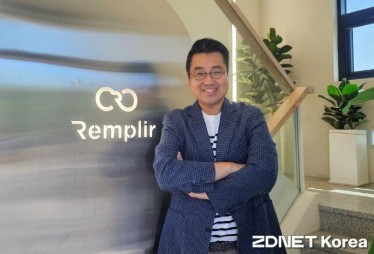
Kim Su-jin, CEO of Remplir (Photo = ZDNet Korea)
|
He also emphasized that the eco-friendly process, which eliminates wastewater, enabled the company to build a production plant in Hwaseong. Remplir established a new production line in Hwaseong last April. CEO Kim stated, "The price is slightly higher than Chinese products, but we are targeting niche markets where demand is growing while simultaneously developing technologies to increase energy density."
Remplir's strategy is to target niche markets such as trucks, heavy equipment, agricultural machinery, golf carts, and electric ships, rather than the electric vehicle battery market, which is the primary focus of the three K-battery companies (LG Energy Solution, Samsung SDI, and SK On). Founded in 2019, Remplir is Korea's first LFP battery company. While the domestic battery industry focused on ternary batteries like nickel, cobalt, and manganese (NCM) and nickel, cobalt, and aluminum (NCA), neglecting LFP due to its low energy density, CEO Kim Su-jin focused on the safety of LFP batteries.
"While researching secondary batteries at the Korea Institute of Science and Technology (KIST), I became interested in the safety of LFP batteries, which have a lower fire risk than ternary batteries," Kim said. "In 2017, I established a joint venture in China to manufacture LFP materials. Seeing the potential for a domestic LFP battery market, I decided to launch the business in Korea in 2019." He continued, "Even if I had developed the materials, no battery company would buy them, so everyone around me tried to dissuade me. Until just two years ago, the perception of LFP was very negative, but now the situation has completely changed." |
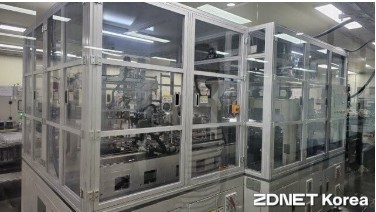
Remplir's Hwaseong plant production line (Photo = ZDNet Korea)
|
This is because battery phobia has spread following electric vehicle fire incidents, and automakers have begun to prefer the cheaper LFP batteries. While electric vehicles face a chasm (temporary slowdown in demand), CEO Kim explained that demand for LFP batteries is growing in niche markets as electrification rapidly expands. He said, "Markets in the Middle East, South America, and Europe that have used Chinese batteries have experienced the disadvantages of using low-quality products and a complete lack of after-sales service. Therefore, demand for Korean batteries, which adhere to deadlines and offer high-quality products at a similar price, is increasing. We're also receiving a lot of interest from overseas."
Next-Generation Battery 'LMFP' in Preparation… Sales Target Doubled Next Year Remplir is also developing LMFP batteries. LMFP replaces some of the iron in the cathode with relatively inexpensive manganese, maintaining the cost and safety of LFP while achieving higher energy density. This next-generation battery is considered a key component. CEO Kim stated, "LMFP battery samples will be available next month," and added, "We're also working to internalize materials, and we've already domestically produced separators and electrolytes." He continued, "We're still sourcing anode materials like graphite from China, but we plan to internalize them starting next year." He added, "There are companies that require high-power LFP, so we anticipate growing demand for LMFP, which has higher energy density than existing LFP, and are accelerating our R&D efforts." |
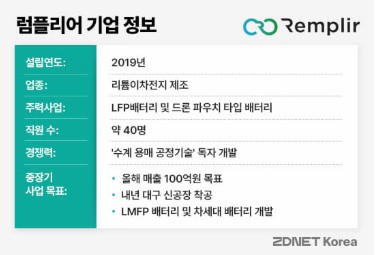
(Graphics = Designer Park Eun-ju)
|
Like LFP, LMFP also emphasized its price competitiveness. He explained, "For ternary batteries using nickel and cobalt, raw material costs increase with increased battery production. However, LFP raw materials are readily available, so even if we sell a large volume, raw material costs won't rise." The company aims to produce both LMFP batteries and materials at its Daegu plant, scheduled to begin construction next year.
CEO Kim stated, "The current production capacity of our Hwaseong plant is approximately 200,000 cells (100 MWh), while our Daegu plant is 1 GWh, ten times that." He added, "We are pursuing capacity expansion due to strong customer demand." He continued, "We are not only producing LFPs, but also generating sales through a two-track approach, including drone batteries. We anticipate sales of 10 billion won this year and aim for four to five times growth next year." He added, "Since small-scale production of a wide variety of products is a market that large companies cannot enter, we are targeting niche markets and will continue to develop and introduce next-generation batteries."
Protecting K-LFP First to Avoid Following Solar Industry Trends... "We Must Prevent Chinese Dominance"
The opening of a government-led energy storage system (ESS) market in Korea could also present opportunities for Lumpler. However, he suggested that detailed government policies are necessary to avoid the same fate that Chinese companies have encroached on the solar industry. |
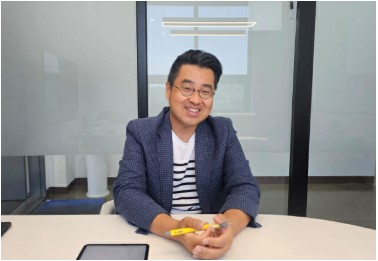
Kim Su-jin, CEO of Remplir (Photo = ZDNet Korea)
|
CEO Kim stated, "ESS uses LFP batteries due to fire risks, but there are currently no domestic manufacturers. As the new administration expands domestic solar power installations, demand for ESS will inevitably increase, leading to corresponding growth in the battery market." He continued, "However, just as Chinese batteries dominated the expansion of renewable energy sources like solar in the past, Chinese batteries will likely benefit from the current ESS revitalization efforts." He emphasized, "If it's difficult to completely eliminate Chinese batteries, institutional improvements, such as providing incentives for domestically produced batteries, are necessary."
Recycling, a key limitation of LFP, is also a technology-enabled issue. Kim stated, "Research on LFP recycling is being conducted, led by China. Recycling is not impossible; it's simply a matter of economic feasibility. Therefore, significant progress will be made in black mass extraction technology over the next five to ten years." |
Reporter Ryu Eun-joo (riswell@zdnet.co.kr)