[Note! This company] First LFP battery to receive KC certification... Secures safety, economy, and environmental friendliness.
 https://www.yeongnam.com/web/view.php?key=20251014023461294
|
| Amidst the Global Secondary Battery Market Leaning Towards China | Possessing Numerous Core Technologies, Including "Aqueous Solvent Process Technology" | Fire-Safe Batteries… Expected to Reach KRW 10 Billion in Sales This Year
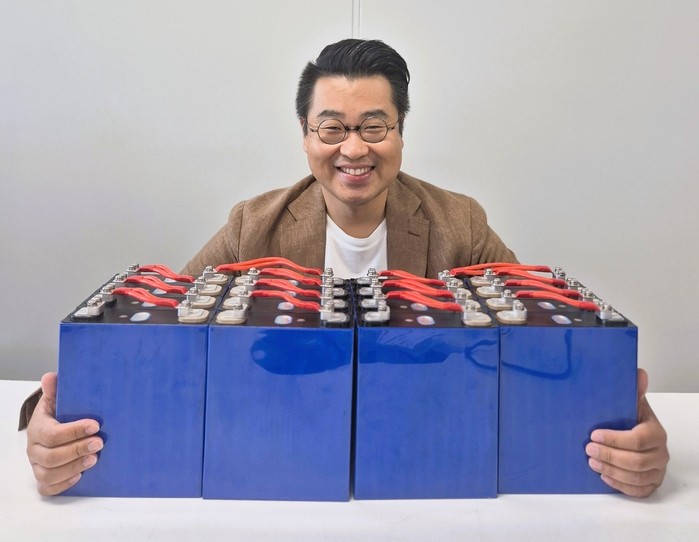
[Kim Su-jin, CEO of Remplir, Korea's first LFP cell manufacturer, smiles brightly while holding the company's prismatic LFP battery. By Lee Seung-yeop.]
The balance of power between Korea and China, which have dominated the global secondary battery market, is gradually shifting toward China. This is due to a rapid market restructuring away from the ternary (nickel, cobalt, manganese) system, which despite its superior efficiency, has revealed safety vulnerabilities such as fire hazards, to LEP (lithium, phosphate, iron) batteries. The gap in global market share between the two countries, which previously focused on ternary (Korea) and LFP (China), has now more than doubled. While Korean companies are belatedly accelerating their transition to LFP batteries, they are considered to lag behind Chinese batteries in both price and technological competitiveness.
However, some analysts argue that there is still a "golden time" left to narrow the gap in LFP technology between Korea and China. The United States, the world's largest market, is blatantly excluding Chinese batteries through the Inflation Reduction Act (IRA) and the Overarching Business-to-Business Tax Reduction Act (OBBBA). The European Union (EU) is also implementing similar provisions through the Critical Materials Regulation Act (CRMA). Therefore, Rumplyer, one of the few Korean companies capable of competing with Chinese LFP batteries in terms of technology and price, is likely to emerge as a beneficiary. Remplir's tenacity in pushing the LFP method from the outset has paid off.
Based in Dong-gu, Daegu, Remplir produces batteries and their applications, which are fundamental to green growth and environmental and energy-related products. The company possesses the core human resources, technology, and facilities to handle the entire process, from the materials process for producing core secondary battery materials to the electrode process and finished battery products.
Kim Su-jin, CEO of Remplir, is an expert who has been researching LFP batteries at the Korea Institute of Science and Technology (KIST) since 2005. In 2017, he founded a battery materials company in China, pursuing technology commercialization. Sensing the rapidly expanding secondary battery market following Tesla's entry into Korea in 2018, he returned to Korea and founded Remplir in 2019.
Remplir possesses unrivaled LFP battery technology in Korea. This year, it became the first LFP battery in Korea to receive Korea Certification (KC), making it the only secondary battery in Korea to be completely free from fire risks. Furthermore, Remplir's proprietary eco-friendly electrode manufacturing technology (aqueous solvent process) has streamlined the entire process by 60% and reduced production costs by 30%. Furthermore, through continued LFP R&D, the company has achieved energy density, previously considered a weakness, reaching 90% of that of ternary batteries.
Remplir's batteries, which combine safety, economic efficiency, and environmental friendliness, are receiving enthusiastic response from the market. CEO Kim expressed confidence, saying, "We expect sales of 10 billion won this year alone, and next year, we will achieve four to five times this year's growth."
Remplir, which currently operates a battery production facility in Hwaseong, Gyeonggi Province, with an annual capacity of up to 30 billion won, will begin operations at its Daegu plant, which will be ten times the size of the Hwaseong plant, as early as the second half of next year. For CEO Kim Su-jin, whose hometown is Andong, North Gyeongsang Province, and most of her family in Daegu, this will be a truly "glorious return home." He stated, "I went to school in Seoul, but most of my family is in Daegu. Daegu feels like my hometown to me." He added, "Given the market structure, LFP batteries are destined to last at least 10 years. We will strive to go public in 2028."
By Lee Seung-yeop, sylee@yeongnam.com |